Do You Need to Replace Your Cameras to Use AI Video Analytics?
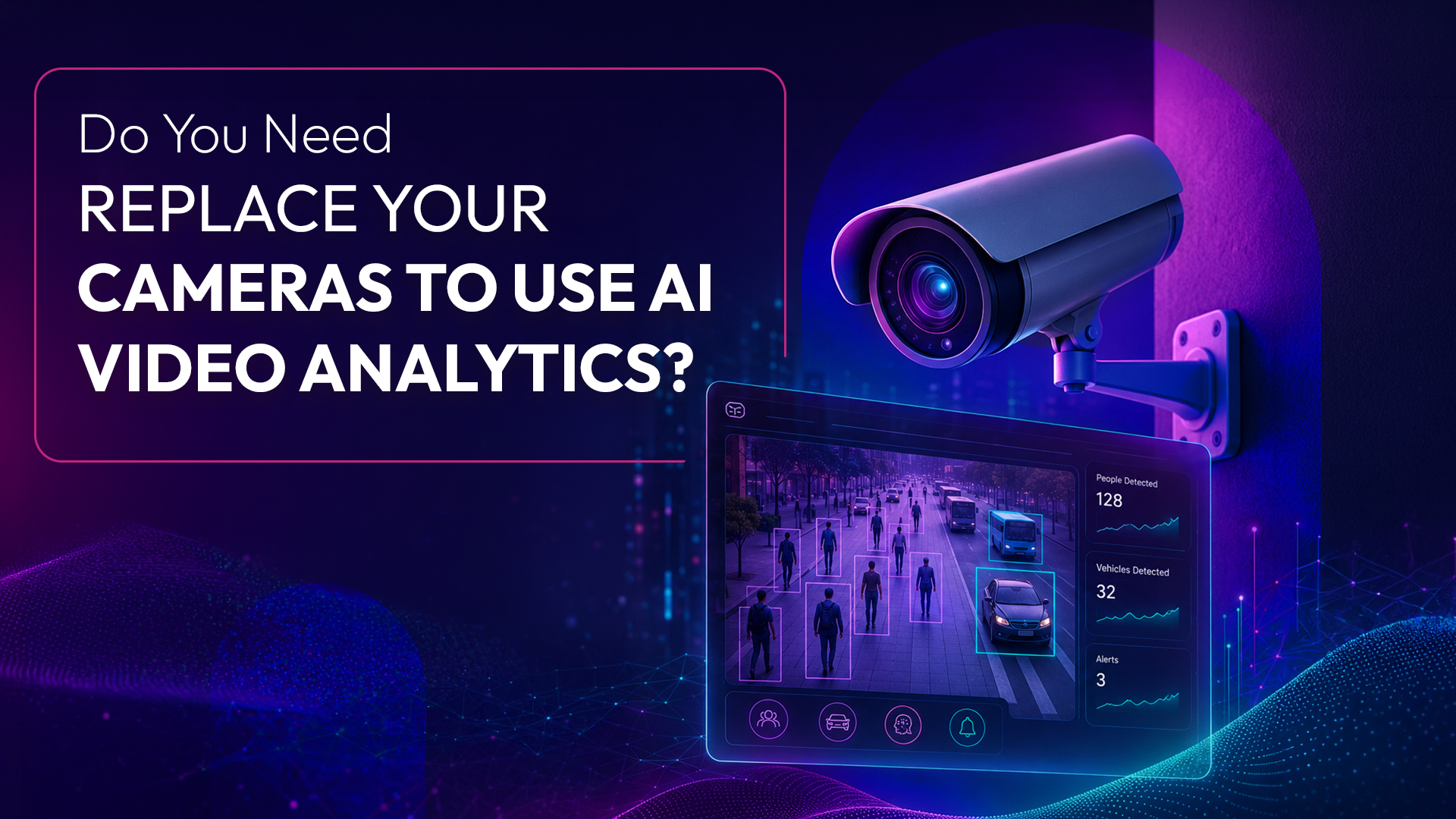
Do You Need to Replace Your Cameras to Use AI Video Analytics?
No. You don't need to replace your cameras to run AI video analytics. Software-based platforms like SentiCam connect to existing IP, analog, and PTZ cameras over ONVIF and RTSP, then add a deep-learning inference layer at the edge. Most sites go live in 48 hours with zero new camera hardware.
This is the single most common misconception in the market — and it costs buyers real money. Teams assume that "AI cameras" means buying AI cameras, so they price a full hardware refresh, see a six-figure number, and shelve the project. The refresh is almost never necessary.
Here's what's actually true, what you genuinely need, and the narrow set of cases where a camera upgrade does help.
Why the "replace everything" assumption is wrong
AI video analytics is software, not a sensor. The intelligence lives in the inference engine, not the lens.
A camera's job is to capture a clean stream. Detecting a person without PPE, counting footfall, or flagging an unauthorized vehicle is the job of a neural network reading that stream. As long as your existing cameras produce a usable feed, modern analytics software can connect to them and do the thinking.
SentiCam is built on exactly this principle: a deep-learning layer that sits on top of the camera network you already own. No rip-and-replace. No cloud dependency. Live in 48 hours.
How camera-agnostic AI actually connects
The reason this works is standards. The surveillance industry settled on common protocols years ago, and good analytics software speaks all of them.
- ONVIF Profiles S, G, T, and M — the interoperability standard that lets software talk to cameras from different manufacturers without custom drivers.
- RTSP, RTP/UDP, and HTTP streaming — the transport protocols that carry the video feed.
- H.265+, H.264, and MJPEG codecs — the compression formats the software decodes.
- Digital encoders for analog — older analog CCTV connects through an encoder that converts the feed to IP. The cameras stay; only a small bridge is added.
SentiCam is tested and compatible with Hikvision, Dahua, Axis, Bosch, and most ONVIF-compliant devices. IP, analog-via-encoder, and PTZ cameras all work, alongside dome, bullet, and fisheye formats.
What you actually need
The requirements are modest, and most operational camera networks already clear them.
| Requirement | Minimum | Recommended |
|---|---|---|
| Camera resolution | 720p | 1080p |
| Network bandwidth | 2 Mbps per stream | 4 Mbps per stream |
| Camera protocol | ONVIF-compatible (or analog + encoder) | ONVIF Profile S/T |
| Processing hardware | Edge box (e.g. ADVIT 16-channel) | Sized to camera count |
| Storage | NAS, DAS, or SAN | Sized during scoping |
The one piece you may add is an edge appliance to run the inference locally. SentiCam's ADVIT Edge Box, for example, supports up to 16 cameras and runs multiple AI models simultaneously — keeping all processing on-premise. That's an addition, not a replacement.
The rare cases where new cameras help
Honesty matters here, so here are the exceptions.
If a camera shoots below 720p, the feed may be too coarse for reliable detection of small objects — license plates at distance, or PPE on a far-side worker. If a camera is badly positioned, no software fixes a view that doesn't show the activity you care about. And very old analog units with heavy noise or low frame rates can limit accuracy.
In these cases you don't replace the network. You replace the handful of cameras that can't do the job — usually a small fraction of the estate, identified during a site assessment.
The cost difference
This is where camera-agnostic AI earns its keep.
A proprietary AI camera system means new hardware across every location — a capital project measured in months. A software overlay like SentiCam reuses what you have, deploys in 48 hours, and lands at roughly 60% lower total cost of ownership than proprietary systems. The savings aren't just the cameras you don't buy; they're the install labor, downtime, and procurement cycle you skip.
FAQ
Will AI video analytics work with my old analog CCTV? Yes, through a digital encoder that converts the analog feed to an IP stream. The cameras stay in place; only a small bridging device is added. SentiCam supports analog-via-encoder alongside native IP cameras.
What's the minimum camera quality for AI analytics? 720p resolution and 2–4 Mbps of bandwidth per stream. 1080p is recommended for finer detection like ALPR, but 720p is enough for most people, vehicle, and zone detection.
Do I need to send video to the cloud? No. SentiCam runs on-premise or at the edge using an appliance like the ADVIT Edge Box, so footage can be processed entirely inside your facility — important for data-residency and compliance requirements.
How do I know if my specific setup is compatible? A site assessment confirms it. SentiCam's team reviews your camera models, resolutions, and network in a short technical call, then flags the rare cameras (if any) that need upgrading before deployment.
---
Not sure if your cameras are AI-ready? Request a free site assessment. [hello@sentiligent.ai]